- Stars:
- Pages: 400 Pages
- Time to Read: 4 hours
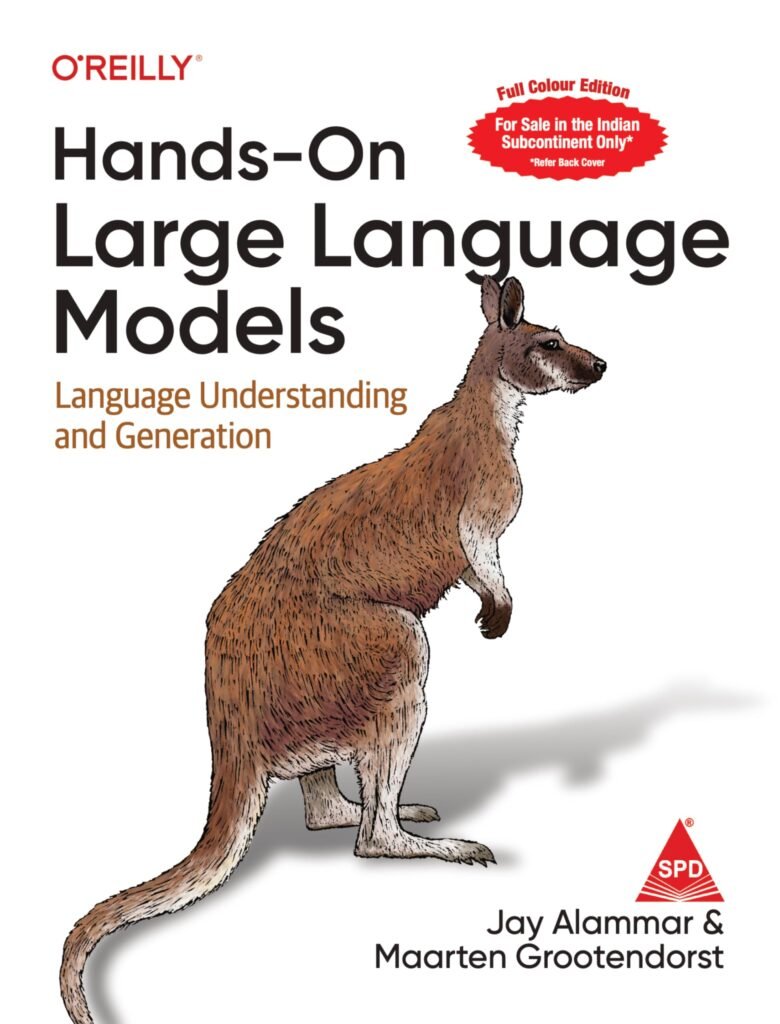
- Authors: Jay Alammar, Maarten Grootendorst
- Type of Book: Artificial Intelligence
TL;DR
Hands-On Large Language Models is a brilliantly executed guide that delivers exactly what its title promises. Authored by two highly respected figures in the NLP community, this book masterfully blends Jay Alammar’s signature, crystal-clear visualizations with Maarten Grootendorst’s practical, hands-on expertise. It strikes the perfect balance between theoretical understanding and real-world implementation, making it the ideal resource for developers, engineers, and practitioners who want to move beyond surface-level API calls and truly understand how to build with LLMs. If you’re looking for a practical, up-to-date, and visually intuitive journey into the world of large language models, look no further.
What is the book about?
This book is a comprehensive, project-driven exploration of building applications with Large Language Models. It takes you from the foundational architecture of Transformers—made famous by Jay Alammar’s “The Illustrated Transformer”—to the deployment of sophisticated AI systems. The authors ensure the “hands-on” promise is kept by grounding every concept in practical code examples, real datasets, and projects you can run yourself on platforms like Google Colab.
The content covers the essential toolkit for a modern NLP developer. You’ll learn to build advanced semantic search engines that outperform simple keyword matching, cluster documents to uncover topics using techniques from libraries like BERTopic, and master the spectrum of model adaptation, from prompt engineering and Retrieval-Augmented Generation (RAGRAGRAGRAG) to various fine-tuning strategies. It’s designed to be the perfect middle ground: deeper than a blog post but more accessible and application-focused than a dense academic paper.
Key Takeaways!
- Visual Learning at Its Finest: The book’s standout feature is its use of intuitive diagrams to deconstruct complex topics. Abstract concepts like the attention mechanism within Transformers become remarkably clear, transforming your understanding from theoretical to tangible.
- A Truly Hands-On Experience: This is not a passive read. The book is packed with practical code, leveraging essential libraries like
Sentence Transformers, and encourages you to actively build and experiment. You learn by doing. - The Perfect Balance of Depth and Accessibility: The authors have found the sweet spot between high-level overviews and deep-in-the-weeds academia. This makes the content incredibly valuable for developers and engineering managers who need a robust working knowledge of LLMs without getting lost in pure mathematics.
- Modern and Practitioner-Focused: The techniques and tools discussed are current and directly applicable to the challenges engineers face today. It provides a relevant, up-to-date roadmap for building real-world LLM-powered systems.
Worth the Read?
An emphatic “Read it.”
This book is a gem and is poised to become a go-to resource for the hands-on LLM practitioner. It successfully demystifies complex topics through a powerful combination of visual learning and practical application.
Read this book if:
- You are a developer, engineer, or data scientist looking to build sophisticated applications with LLMs.
- You are a visual learner who benefits from clear diagrams and explanations of complex architectures.
- You want a guide that is technically robust but remains accessible and focused on practical outcomes.
- You want to bridge the gap between understanding LLM concepts and actually implementing them in code.
Minor Caveats:
While overwhelmingly excellent, a few readers have noted that some diagrams could benefit from more detailed textual explanations and that the chapter on fine-tuning is lighter on code examples than other sections. However, these are minor points in an otherwise outstanding book. For those seeking purely theoretical depth or a superficial “quick-start” guide, other books might be more suitable. But for its intended audience, this book is nearly perfect.

Join to get sneak peek into what's happening
I write about books, experiences, product, UX, EdTech, early stage growth, validation – mostly tech. Subscribe if these topics interest you. Once every 15 days emailer. I promise – No spam. (I am known for it otherwise) 😉