- Stars:
- Pages: 304 Pages
- Time to Read: 6 hours
- Authors: Josh Starmer
- Type of Book: Artificial Intelligence
TL;DR
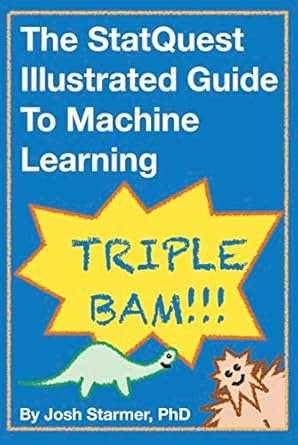
The StatQuest Illustrated Guide to Machine Learning is a masterclass in making complex topics accessible and, dare I say, fun. Josh Starmer translates the magic of his wildly popular YouTube channel into a physical book that uses simple, colourful illustrations to build a deep, intuitive understanding of machine learning concepts. It bypasses dense mathematical proofs and code-heavy tutorials in favour of step-by-step visual explanations. For anyone who has ever felt intimidated by machine learning or drowned in jargon, this book is the perfect entry point. It’s an enthusiastic and unequivocal “must-read” for beginners.
What is the book about?
This book serves as a foundational guide to the core concepts of machine learning. True to the StatQuest style, it begins with the absolute basics: what is machine learning and what are its primary goals? From there, Starmer methodically builds the reader’s knowledge, one concept at a time. Each new idea, whether it’s a fundamental statistical concept or a complex algorithm, is broken down into bite-sized pieces and explained with clear illustrations.
Instead of presenting you with a wall of equations for an algorithm like a Decision Tree or a Neural Network, the book walks you through the logic visually. You’ll see how the data is split, how the model “learns,” and how it makes predictions, all shown through simple diagrams. The focus is squarely on the intuition and the why behind the methods, not on the specific programming implementation. It’s designed to arm you with the conceptual understanding needed to later tackle the practical coding aspects with confidence.
Key Takeaways!
- Intuition Over Intimidation: The book’s greatest strength is its ability to build an intuitive feel for how algorithms work. The visual approach ensures you grasp the core logic before getting bogged down in complex mathematics or code syntax.
- A Solid Conceptual Foundation: This is not a coding manual. Its purpose is to give you a rock-solid understanding of the concepts before you start writing code. Readers will come away knowing the difference between regression and classification, what overfitting is, and the logic behind various models, which is invaluable for any aspiring data scientist.
- Learning is Structured and Cumulative: The book is brilliantly structured to build upon previous chapters. It starts simple and gradually introduces more complex topics, ensuring the reader is never overwhelmed. This makes it an ideal resource for self-study.
- Demystifies the Jargon: Starmer excels at cutting through the often-confusing terminology of machine learning. Concepts are explained in plain English, making the field accessible to a much broader audience, from students to professionals transitioning from other industries.
Worth the Read?
Read it.
The StatQuest Illustrated Guide to Machine Learning is an exceptional resource that succeeds perfectly in its mission. It bridges the gap between being a complete novice and being ready to tackle more advanced, code-intensive machine learning resources.
Read this book if:
- You are a complete beginner and want to understand the fundamentals of machine learning.
- You are a visual learner who benefits from diagrams and illustrations.
- You are a student or professional who needs a clear, high-level overview of the field without getting lost in the mathematical weeds.
- You’ve tried to learn ML before but found other resources too dense or intimidating.
Skip this book if:
- You are an experienced ML practitioner looking for advanced, cutting-edge techniques.
- You are specifically looking for a book that will teach you how to implement algorithms in Python or R.
For its intended audience, this book is one of the best educational resources available. It doesn’t just teach you; it builds your confidence and makes you feel like you truly understand the magic behind machine learning.

Join to get sneak peek into what's happening
I write about books, experiences, product, UX, EdTech, early stage growth, validation – mostly tech. Subscribe if these topics interest you. Once every 15 days emailer. I promise – No spam. (I am known for it otherwise) 😉