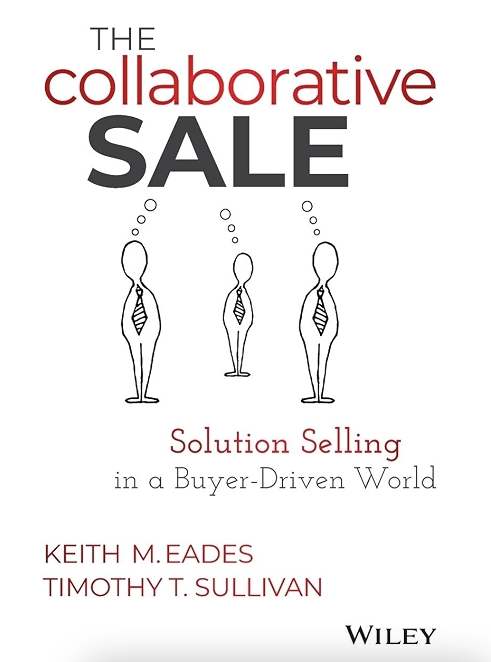
This review is for executives, operators, and strategists who understand that the traditional sales playbook is obsolete. In a world where buyers are hyper-informed and in control, success hinges on a fundamental shift in approach. The Collaborative Sale by Keith M. Eades and Timothy T. Sullivan offers a pragmatic, yet profound, framework for navigating this new landscape. It’s not just about selling; it’s about partnering with customers to solve their most pressing problems.
Executive Summary
In today’s buyer-driven world, the rigid, product-centric sales models of the past are dead. The Collaborative Sale provides a compelling, actionable blueprint for sales organizations to thrive by truly understanding and co-creating solutions with customers, transforming sales from a transactional event into a strategic partnership that drives sustained revenue and loyalty.
Key Insights
This book is a goldmine of actionable intelligence for anyone responsible for revenue generation and customer engagement. Here are the core takeaways that will resonate with discerning leaders:
- The Buyer’s Journey Reigns Supreme: Eades and Sullivan forcefully argue that the buyer’s journey, not the seller’s process, dictates the sales cycle. This fundamental shift demands that sales teams align their activities, messaging, and offerings to mirror the customer’s discovery, evaluation, and decision-making process. For CX leaders, this translates directly into understanding customer touchpoints, mapping their pain points at each stage, and ensuring a seamless, supportive experience. Neglecting this means losing opportunities before they even materialize as a formal inquiry. This insight directly impacts customer retention; when buyers feel understood and guided through their problem-solving journey, their commitment to the solution provider deepens.
- Shifting from Product Pushing to Problem Solving: The authors dismantle the myth of the “feature-dump” sales pitch. Instead, they advocate for a deep dive into understanding the customer’s business challenges, objectives, and desired outcomes. This requires sophisticated questioning, active listening, and a genuine desire to diagnose before prescribing. For operators, this means equipping sales teams with the tools and training to become consultative experts, not just product evangelists. This focus on solving real problems is a cornerstone of superior customer experience. When customers see a vendor as a trusted advisor capable of resolving their critical issues, loyalty is cemented. This directly fuels revenue growth through deeper engagements and increased likelihood of repeat business and referrals.
- The Power of Co-Creation and Shared Risk: A truly collaborative sale involves the customer as an active participant in crafting the solution. This means engaging them in defining the problem, exploring options, and even participating in pilot programs. This shared ownership reduces perceived risk for the buyer and fosters a sense of partnership. For strategists, this means rethinking how R&D, product management, and sales collaborate to ensure solutions are not just theoretically sound but practically implementable and valuable to the customer. This approach significantly boosts customer retention by embedding the vendor’s solution deeply within the customer’s operational fabric. It also opens doors for upselling and cross-selling as the initial co-created solution proves its worth.
- Leveraging a “Value Proposition Canvas” for Strategic Alignment: The book introduces practical frameworks, such as a customized Value Proposition Canvas, to systematically map customer needs against proposed solutions. This ensures that every element of the sales engagement is directly tied to delivering tangible business value. For sales leadership, this translates into a more disciplined and effective sales process, moving away from gut instinct to data-driven, value-focused conversations. This rigor is essential for operational efficiency in sales. By clearly articulating and demonstrating value, sales cycles can be shortened, and deal sizes can be increased, directly contributing to revenue growth.
Practical Application
Implementing The Collaborative Sale isn’t an overnight transformation, but certain steps can be taken immediately to shift the paradigm:
- Revamp Sales Training with a “Buyer-Centric Inquiry” Module: Dedicate immediate resources to re-training your sales force, focusing on advanced questioning techniques and active listening skills. This training should move beyond product features and delve into understanding customer business strategy, challenges, and desired outcomes. Incorporate role-playing scenarios that simulate deep diagnostic conversations, emphasizing empathy and problem-solving. Task sales managers with conducting weekly coaching sessions specifically on these new inquiry skills, holding reps accountable for uncovering customer needs before pitching solutions. This will directly enhance the quality of customer interactions, improving initial engagement and setting the stage for more fruitful conversations.
- Implement a “Solution Design Workshop” with Key Accounts: For your top-tier accounts, proactively offer a “Solution Design Workshop.” This isn’t a traditional sales pitch. Instead, invite key stakeholders from the customer side (business leaders, operational managers, IT if relevant) to collaboratively explore a specific business challenge they are facing. Equip your sales team with facilitators trained in Eades and Sullivan’s methodologies to guide this session. The goal is not to sell a specific product but to co-create a potential solution framework that addresses their identified pain points. This hands-on approach, demonstrating a commitment to partnership and problem-solving, will foster immense goodwill, build deeper relationships, and significantly de-risk future sales engagements. It also provides invaluable insights for your product development teams.
Final Verdict
- Who Must Read This: Every sales leader, VP of Sales, Chief Revenue Officer, Head of Customer Success, and senior executive involved in go-to-market strategy. If your current sales approach feels increasingly like an uphill battle against informed buyers, this book is essential. It provides the intellectual ammunition and practical guidance to adapt and thrive.
- Who Can Skip It: Tactical sales representatives who are not empowered or expected to engage in strategic problem-solving with C-suite executives, or organizations with truly commoditized offerings where differentiation is purely price-based and transactional. Even then, understanding these principles can offer a competitive edge.
- Bottom-Line Rating: 5/5 Stars
The Collaborative Sale is more than just a book; it’s a manifesto for modern selling. Eades and Sullivan have delivered a critical guide that acknowledges the seismic shift in the buyer-seller dynamic and offers a robust, proven pathway to not just survive, but dominate in this new era. For executives committed to sustainable revenue growth and building lasting customer relationships, this is required reading. Its emphasis on partnership, deep customer understanding, and co-creation directly translates into improved customer experience, enhanced retention, and ultimately, a more robust and predictable revenue stream. This book is a tactical and strategic imperative.
In exploring the themes presented in “The Collaborative Sale: Solution Selling in a Buyer Driven World” by Keith M. Eades and Timothy T. Sullivan, readers may find it beneficial to delve into the article on UX and product management alignment. This piece discusses how effective collaboration between UX designers and product managers can enhance the overall sales process by ensuring that products meet buyer expectations and needs. For more insights on this topic, you can read the article here: The UX and Product Management Alignment.
The Collaborative Sale: A Deep Dive for the Modern Executive
In the relentless pursuit of growth and customer loyalty, business leaders are constantly bombarded with advice, frameworks, and methodologies promising a silver bullet. Yet, many of these solutions fail to account for the most significant shift in modern commerce: the ascendancy of the informed, empowered buyer. The Collaborative Sale: Solution Selling in a Buyer-Driven World by Keith M. Eades and Timothy T. Sullivan is a beacon of clarity and pragmatism in this often-clouded landscape. This is not a book for the faint of heart or those clinging to outdated sales tactics; it is a call to action for leaders ready to embrace a fundamentally different approach to revenue generation.
In exploring the themes presented in “The Collaborative Sale: Solution Selling in a Buyer Driven World” by Keith M. Eades and Timothy T. Sullivan, one can gain further insights into effective communication strategies that resonate with modern audiences. A related article discusses the top essentials of storytelling for online courses, emphasizing how narrative techniques can enhance engagement and understanding in educational settings. This connection highlights the importance of adapting sales approaches to meet the evolving needs of buyers, much like how educators must tailor their methods to captivate learners. For more on this topic, you can read the article on storytelling essentials here.
The Erosion of Traditional Sales Power
For decades, the sales playbook was largely dictated by the seller. Companies possessed superior product knowledge, controlled access to information, and dictated the terms of engagement. The sales representative was the gatekeeper, the expert, the one holding the keys to the kingdom of solutions. However, the digital revolution, the proliferation of information, and the democratization of knowledge have irrevocably altered this power dynamic. Buyers today conduct extensive research before ever engaging with a sales representative. They compare options, read reviews, consult peers, and form strong opinions long before a vendor gets a chance to present. This reality renders the old-school, product-pushing approach not only ineffective but actively detrimental.
The Buyer’s Unprecedented Control
Eades and Sullivan masterfully articulate this shift, emphasizing that the sales process must now be architected around the buyer’s journey. This isn’t a minor tweak; it’s a paradigm shift. The traditional sales funnel, with its distinct stages of awareness, consideration, and decision, is increasingly less relevant. Instead, buyers navigate a fluid, often non-linear path of discovery, evaluation, and commitment. They may enter the funnel at any point, armed with a wealth of information. Sales teams that fail to recognize and adapt to this reality will find themselves consistently outmaneuvered.
Implications for Customer Experience
From a Customer Experience (CX) perspective, this insight is paramount. It means that every touchpoint, every piece of content, every interaction needs to be designed with the buyer’s current stage of research and decision-making in mind. If a buyer is in the early discovery phase, they need educational content, not a sales pitch. If they are evaluating options, they need comparative data and proof points, not generic product descriptions. For CX leaders, this requires a deep understanding of customer journey mapping, not just from a transactional perspective, but from an informational and emotional one. Understanding why a buyer is researching, what problems they are trying to solve, and how they prefer to consume information is critical. This proactive alignment with the buyer’s needs is the bedrock of superior CX and lays the foundation for strong customer retention.
The Diminishing Returns of Feature-Benefit Selling
The authors powerfully debunk the myth that customers buy based on a list of features and benefits. While these elements are important, they are secondary to the customer’s core need to solve a pressing business problem. In a buyer-driven world, simply listing what your product does is akin to speaking a foreign language. Customers are not interested in your product’s capabilities; they are interested in how your product can alleviate their pain, achieve their goals, and improve their business outcomes.
Driving Revenue Growth Through Problem-Centricity
This necessitates a profound shift in the sales conversation. Instead of starting with “Our product does X, Y, and Z,” the conversation must begin with “What are the critical challenges you are facing in area A, and what are your desired outcomes for B?” This requires sales professionals to become sophisticated diagnosticians, skilled in asking probing questions, active listening, and drawing out the nuanced complexities of a customer’s situation. For revenue growth, this translates into deeper, more meaningful engagements. When sales teams consistently demonstrate an ability to understand and address fundamental business problems, they build trust and credibility, positioning themselves as indispensable partners rather than mere vendors. This leads to larger deal sizes, longer sales cycles (in a positive, strategic way), and a higher probability of closing.
The Pillars of Collaborative Selling
The Collaborative Sale isn’t just about identifying problems; it’s about building a framework for proactively solving them with the customer. The authors outline several key pillars that underpin this collaborative approach.
The Ascendancy of Solution Co-Creation
One of the most impactful concepts presented is the idea of solution co-creation. This moves beyond the seller presenting a pre-packaged solution and instead involves the buyer as an active partner in designing and refining the solution itself. This collaborative process has profound implications for both customer retention and operational efficiency.
Enhancing Customer Retention Through Shared Ownership
When customers are actively involved in shaping the solution, they develop a sense of ownership and investment. They are not simply recipients of a product; they are co-creators of their own success. This shared responsibility fosters a deeper commitment to the chosen solution and the vendor providing it. Imagine a customer not just buying a software platform, but actively participating in its configuration, testing, and rollout, with your sales team guiding and facilitating each step. This level of engagement dramatically reduces the likelihood of churn. The solution becomes intertwined with the customer’s operational DNA, making it far more difficult and costly to divest from. This collaborative spirit also makes customers more receptive to future iterations and expansions of the solution, as they trust the process and value the ongoing partnership.
Streamlining Operational Efficiency with Customer Alignment
From an operational standpoint, co-creation can lead to a more efficient and effective implementation process. By involving the customer in the design, potential roadblocks, technical challenges, and user adoption hurdles can be identified and addressed early in the process. This iterative feedback loop ensures that the final solution is not only technically sound but also practically aligned with the customer’s day-to-day operations and user needs. This proactive problem-solving minimizes costly rework, reduces implementation delays, and leads to a smoother, more successful deployment. For operational leaders, this translates into reduced support burdens, faster time-to-value for the customer, and a more predictable and scalable service delivery model.
The Strategic Importance of the Value Proposition Canvas
Eades and Sullivan introduce practical tools and frameworks to operationalize their collaborative approach. The Value Proposition Canvas, adapted and emphasized within the context of collaborative selling, is a prime example. This isn’t just a marketing exercise; it’s a strategic tool for aligning sales efforts with genuine customer needs and desired outcomes.
Driving Revenue Growth Through Tangible Value Articulation
By systematically mapping the customer’s pains, gains, and jobs-to-be-done against the products’ pain relievers, gain creators, and features, sales teams can construct compelling, value-driven narratives. This ensures that every sales interaction is focused on demonstrating tangible business outcomes. For revenue growth, this is transformative. Instead of selling on price or features, you are selling on the ROI, the efficiency gains, the risk mitigation, and the strategic advantage your solution provides. This higher-level value proposition justifies premium pricing, shortens sales cycles by reducing perceived risk, and increases deal sizes because customers understand the profound impact of the investment. This framework empowers sales teams to have conversations that resonate with C-suite executives, moving beyond departmental concerns to strategic business objectives.
Enhancing CX Through Clear Value Communication
For CX leaders, this framework provides a consistent language for communicating value. When the sales team is aligned with this canvas, the entire customer lifecycle can be informed by a clear understanding of what constitutes success for the customer. This ensures that post-sale support, customer success management, and ongoing engagement are all focused on delivering on the promised value. This consistency builds trust and reinforces the customer’s decision, leading to higher satisfaction and a stronger likelihood of advocacy. It bridges the gap between what was sold and what is delivered, a critical factor in long-term customer loyalty.
Implementing the Collaborative Sale: Actionable Steps
Transitioning to a collaborative sales model requires a conscious effort and a commitment from leadership. Here are two practical ways to begin this transformation immediately:
1. Develop “Customer Challenge Deep Dive” Sessions
Instead of traditional product demos, schedule “Customer Challenge Deep Dive” sessions with your key prospects and existing clients. These sessions should be structured as collaborative workshops, not sales pitches. The agenda should be focused on eliciting information about the customer’s most pressing business challenges, their desired future state, and the obstacles they face in achieving it.
Actionable Steps:
- Equip your sales team with a structured set of open-ended, diagnostic questions designed to uncover needs, priorities, and desired outcomes. These questions should move beyond surface-level inquiries to probe strategic intent and operational impact.
- Train sales managers to facilitate these sessions effectively, focusing on active listening, paraphrasing, and summarizing to ensure full understanding. The goal is to make the customer feel heard and understood.
- Document key insights and collaboratively brainstorm potential solutions with the customer present. This could involve sketching out process flows, identifying key stakeholders, or defining critical success factors for a proposed solution. This shared activity builds immediate rapport and demonstrates genuine partnership.
This approach directly addresses the “buyer-driven world” by putting the customer’s challenges at the forefront, fostering trust and establishing credibility as a problem-solver, not just a product peddler. This will improve the quality of initial sales interactions and significantly enhance the probability of closing deals that genuinely solve customer problems, thereby improving long-term retention.
2. Implement a “Value Realization Framework” for Post-Sale Success
The collaborative sale doesn’t end at the contract signature; it extends into ensuring the customer achieves the promised value. Implement a “Value Realization Framework” that actively tracks and communicates the tangible benefits the customer is receiving from your solution.
Actionable Steps:
- Define key performance indicators (KPIs) for success collaboratively with the customer during the sales process. These KPIs should directly align with the business challenges and desired outcomes discussed.
- Develop regular (e.g., quarterly) business reviews (QBRs) that focus not on product updates, but on demonstrating the achievement of these agreed-upon KPIs. Present data and insights that clearly show the ROI and business impact your solution is delivering.
- Empower your Customer Success team to actively manage this framework, working proactively with customers to optimize their usage and ensure they are maximizing the value they receive. This might involve identifying underutilized features, suggesting best practices, or highlighting new use cases that align with evolving customer needs.
This framework directly supports customer retention by ensuring that the value proposition made during the sale is continuously delivered and demonstrably proven. It transforms the post-sale relationship from one of transactional support to strategic partnership, which is essential for long-term customer loyalty and reduces churn. Furthermore, by actively demonstrating value, you create natural opportunities for upsells and cross-sells as the customer seeks to expand on their successes.
Final Verdict
The Collaborative Sale: Solution Selling in a Buyer-Driven World is a masterclass in adapting sales and customer engagement strategies to the realities of today’s market. Eades and Sullivan have provided a timely, practical, and deeply insightful guide for any executive or operator serious about driving sustainable revenue growth and building enduring customer relationships.
- Who Must Read This: This book is mandatory reading for all sales leaders, VPs of Sales, Chief Revenue Officers, Heads of Customer Success, and anyone involved in defining go-to-market strategy. If your organization is struggling to connect with modern buyers or feels like its sales efforts are increasingly misaligned with customer needs, this book offers a clear and actionable path forward. It is also highly relevant for product leaders seeking to build solutions that truly resonate with market demand.
- Who Can Skip It: Organizations operating in a purely transactional, price-sensitive commodity market where differentiation is solely based on cost, or individual sales contributors who are strictly limited to scripted product pitches and have no autonomy to engage in consultative problem-solving, may find less immediate utility. However, even in these scenarios, understanding these principles can provide a strategic advantage.
- Bottom-Line Rating: 5/5 Stars.
This book is a game-changer. It’s not just about selling; it’s about becoming an indispensable partner to your customers. By shifting focus from product pushing to collaborative problem-solving, organizations can unlock deeper customer loyalty, achieve more predictable revenue growth, and build a truly defensible competitive advantage. The Collaborative Sale is the essential playbook for navigating the complexities of the buyer-driven world.
FAQs

1. What is the main focus of “The Collaborative Sale: Solution Selling in a Buyer Driven World” by Keith M. Eades and Timothy T. Sullivan?
The main focus of the book is on the shift in the sales process from a traditional seller-driven approach to a more collaborative and solution-oriented approach in response to the changing dynamics of the modern buyer-driven world.
2. What are some key concepts or strategies discussed in the book?
The book discusses the importance of understanding the buyer’s perspective, building trust, and collaborating with buyers to co-create solutions that meet their specific needs. It also emphasizes the use of data and insights to inform the sales process and drive better outcomes.
3. Who is the target audience for this book?
The book is primarily targeted towards sales professionals, sales leaders, and anyone involved in the sales process who wants to adapt to the changing dynamics of the buyer-driven world and improve their sales effectiveness.
4. What sets “The Collaborative Sale” apart from other sales books?
The book stands out for its focus on collaboration and solution selling, as well as its practical strategies and actionable insights that can be applied in real-world sales situations. It also addresses the impact of technology and data on the sales process.
5. What are some of the key takeaways or lessons from “The Collaborative Sale”?
Some key takeaways from the book include the importance of understanding the buyer’s journey, building trust and credibility, leveraging data and insights, and adopting a collaborative mindset to drive successful sales outcomes in a buyer-driven world.